Bristol · BS8 · Carpentry by area
Carpentry in Clifton
Professional first and second fix carpentry for new builds, renovations and extensions. TM Carpentry delivers the structural and finishing carpentry that forms the backbone of any project. First fix includes stud walls, floor joists, roof timbers, noggins and door linings before plastering, while second fix covers skirting boards, architraves, internal doors, stair components and ironmongery after the plastering is complete. Whether we’re working as part of a larger renovation or managing the entire project, we ensure every stage is completed to the highest standard. Serving Bath, Bristol and Keynsham.
What's included
What's included
Every structural carpentry job covers the items below — always. The exact specification depends on your space and what you want it to do.
Stud partition walls, timber framing and noggins (first fix)
Floor joists and structural first-fix carpentry
Door linings, frames and casings (first fix)
Skirting boards and architraves (second fix)
Door hanging and ironmongery — handles, hinges, locks (second fix)
Loft hatches, coving and finishing trim (second fix)
A real job
Recent carpentry project in Clifton
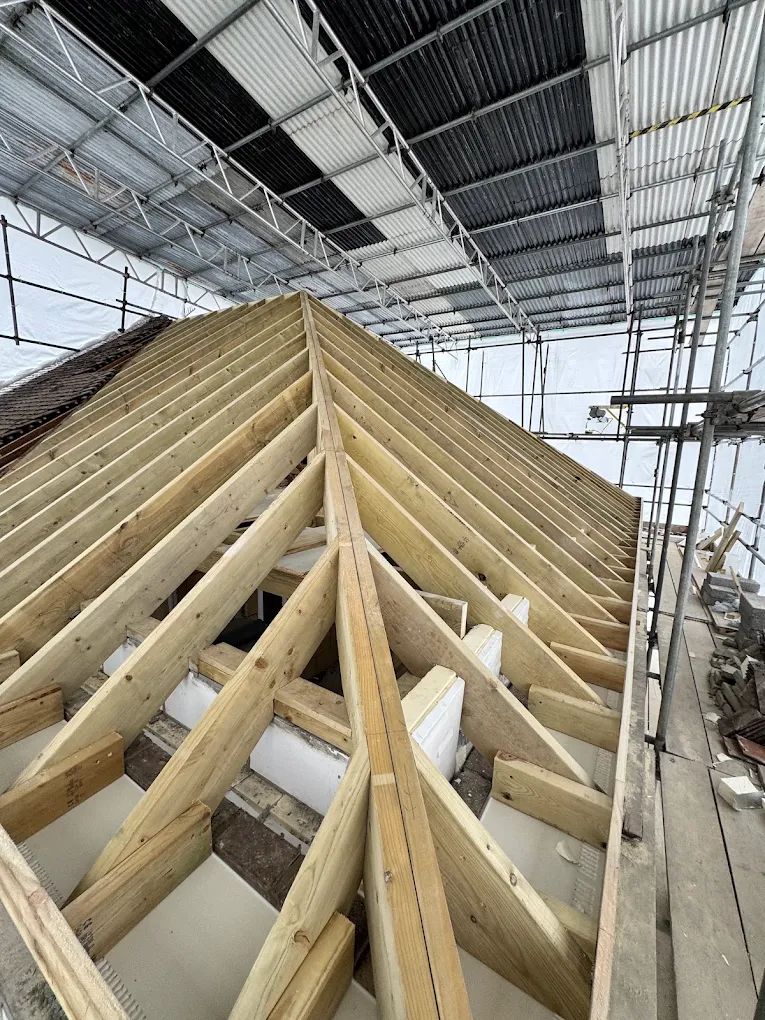
Clifton · Structural Carpentry
From a recent Clifton job — a self-build or extension where Tom ran the structural and finishing carpentry across the programme. [Real project story placeholder. Replace with the specific job: the customer, what they wanted, what was tricky about the site, how it turned out. The photo shows a roof structure timber frame under construction.]
About Clifton
What carpentry typically looks like in Clifton
Clifton is dominated by Regency and Victorian villas and mansion blocks. Many individual properties are Grade II listed. The dominant work is sensitive renovation of heritage properties and extension framing on the larger villas.
Honest note: The descriptions below are generalisations — what's typical or commonly found in Clifton, based on the area's documented housing stock. Every project is different, so Tom will always confirm what's actually needed on the site visit before quoting.
Typical property types
- Regency villas
- Victorian mansion blocks
- Grade II listed houses
Planning & permissions
The planning context in Clifton
Common extension patterns in Clifton
Clifton carpentry patterns: replacement floor joists on the suspended timber subfloor (typically 7x2 or 9x2 C24 graded timber), stud partition walls for kitchen/bathroom reconfigurations (typically 4x2 or 6x2 C16/C24 graded timber), door linings and frames (typically softwood), then finishing: skirting and architrave matching the original Victorian profile (typically 120-180mm), door hanging with brass or chrome ironmongery, loft hatches, and finishing trim. Most Clifton jobs run on day-rate (£200-£350/day) or fixed-price for larger projects.
Local questions
Clifton — common questions
My Clifton property is Grade II listed — can I replace the original floor joists?
What's the typical day rate for Clifton structural carpentry?
How long does a Clifton stud wall take?
Can you match the original Victorian skirting profile?
Are you VAT registered?
Carpentry in other Bristol areas
More carpentry by area
- RedlandVictorian terraces, mixed CA status
- BishopstonFamily homes, busy high street
- SouthvilleWorking streets, standard housing
- Henleaze1930s semis, generous housing
- Cotham & MontpelierConservation areas, Victorian terraces
- BedminsterWorking streets, standard housing
- Westbury-on-Trym & Stoke BishopLarger family homes, generous housing
Our step by step process
Our step by step process
Every job follows the same six stages. Some are quicker, some are slower — but the order and what to expect at each point is fixed, so you're never wondering what's happening.
- 01
Scope and programme
What stage of the build this is, what's needed, and how it fits the wider programme — whether that's a main contractor's schedule or your own as a self-builder.
- 02
First fix
Stud walls, floor joists, door linings and noggins for fixtures — the structural carpentry that has to be right before plastering starts.
- 03
Second fix
After plastering: skirting, architrave, doors hung and ironmongery fitted, loft hatches and finishing trim.
- 04
Snagging and sign-off
Final adjustments, gaps filled, everything checked before handover to the next trade or to you.
Carpentry by city
Structural and finishing carpentry in Bath or Bristol
Pick a city to see what's distinctive about carpentry there — housing stock, typical scope (renovation, extension, new-build), day-rate work, and FAQs — and a curated list of area hubs beneath it.
Get in touch
Ready to talk about your structural carpentry?
Tell us what you have in mind — we'll come back with a written quote and a realistic timeline.
Start a conversation →